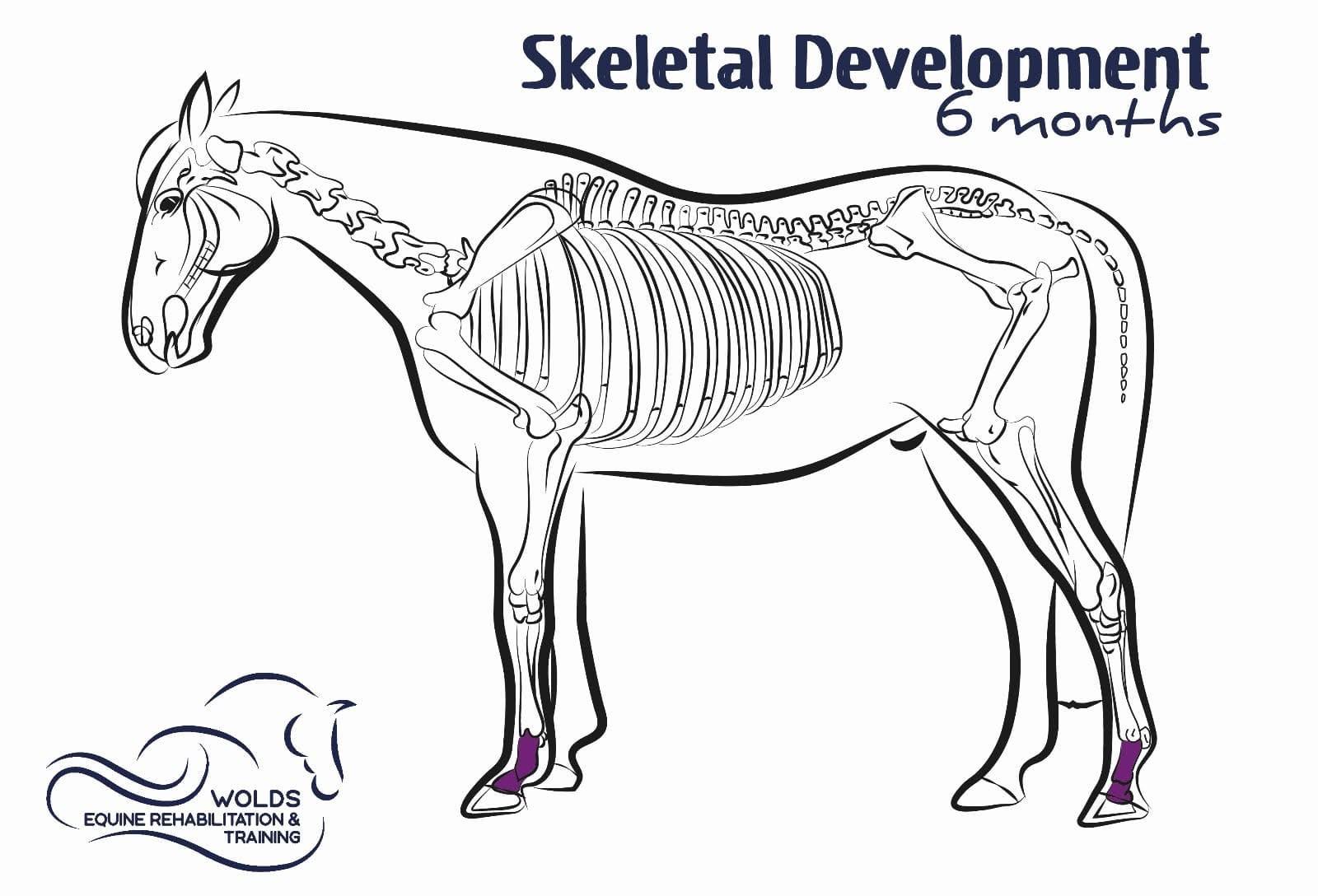
At around six months old, the foal is growing rapidly. The limbs are developing quickly and many of the lower limb growth plates are already beginning to close.
Even though foals can often look surprisingly coordinated and athletic, the skeleton is still extremely immature overall. Soft tissues, joints, and posture are all adapting constantly during this stage.
This is why good nutrition, correct handling, turnout, and careful management matter so much early on.
Yearlings often go through awkward growth phases where the body seems out of proportion. One week they appear bum high, the next they level out again.
The lower limbs are becoming more developed, but the horse is still immature through the spine, pelvis, and larger joints. Coordination can fluctuate because the body is changing so quickly.
This is often the stage where people notice clumsiness, growth spurts, and uneven muscle development.
By two years old, many horses look physically capable of work. This is where confusion often begins because externally the horse may appear mature enough to cope with far more than the skeleton is actually ready for.
The limbs are continuing to strengthen, but the spine and pelvis are still developing significantly. The horse may cope mentally and physically with light education, but repetitive strain, excessive circles, overloading, or too much collected work can place stress on immature structures.
This is the age where management and sensible progression become very important.
At three, many horses begin ridden work. Some areas of the body are becoming stronger and more stable, but the topline and spinal support system are still developing.
The horse is usually capable of handling more structured exercise, but fatigue can still show quickly because the postural muscles are immature.
This is often where bodyworkers begin noticing compensation patterns developing if the horse is pushed faster than their strength allows.
Interestingly, many horses go through a slightly weak or unbalanced stage around three and a half.
The body is still growing, the pelvis and spine are still maturing, and the horse may suddenly feel less coordinated or more on the forehand. Some horses become tighter through the back or struggle with carrying power behind consistently.
This is why slow strengthening work, straightness, pole work, core activation, and careful workload management become so valuable at this age.
By four years old, many horses start to look and feel far more established in their bodies. Strength, balance, and muscle development begin improving noticeably if training has been sensible.
However, although the horse may now look mature externally, the spine is still not fully developed. This is important because many performance expectations increase dramatically at this stage.
The horse may cope better physically, but recovery, posture, and muscle fatigue still need careful monitoring.
At five, many horses are becoming far stronger through the topline, pelvis, and thoracic sling. The body is usually handling workload more efficiently and muscle development often improves rapidly during this stage.
For many horses, this is where they begin feeling more consistent under saddle and more capable of carrying themselves properly.
But even here, some areas of the spine are still finishing development.
One of the last areas to fully mature is the spine, particularly towards the upper cervical region and parts of the vertebral column.
This means that although the horse may have been in work for years already, aspects of skeletal maturity are still finishing at around six years old in many horses.
This is why long-term soundness relies so heavily on correct development early on. Good posture, progressive strengthening, correct saddle fit, balanced training, turnout, nutrition, and appropriate workload all help support the skeleton while it matures.
The important thing to remember is that skeletal development is not about avoiding work altogether. Movement is essential for healthy development. The key is appropriate work for the horse’s stage of maturity.
Young horses need time to build strength, coordination, posture, and stability gradually.
Sometimes what looks like “naughtiness”, weakness, stiffness, or imbalance is simply an immature body still trying to organise itself physically. Understanding that can completely change how we train, manage, and support our horses as they grow.”